The Tunguska Event (Occurred June 30, 1908, Investigated 1927)
- Location: Siberia, Russia.
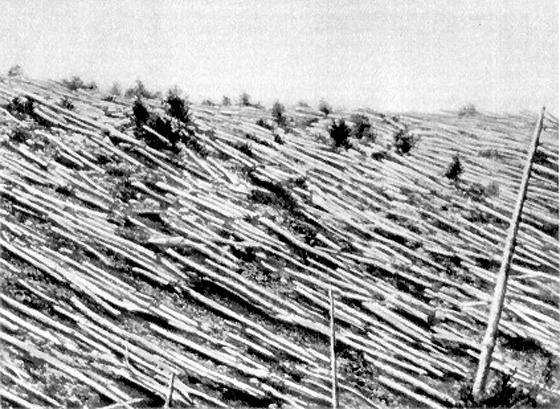
- Findings: A massive explosion flattened over 2,000 square kilometers of forest. No crater was found, leading scientists to conclude it was likely caused by the airburst of a comet or asteroid.
The Tunguska Event: A Mysterious Explosion in Siberia
On the morning of June 30, 1908, a massive explosion rocked a remote area of Siberia near the Tunguska River. The event flattened over 2,000 square kilometers of forest, toppling an estimated 80 million trees and sending shockwaves that were detected as far away as Europe. Despite its magnitude—estimated to be equivalent to 10–15 megatons of TNT—no impact crater was found, adding to the mystery of what caused this catastrophic event.
The explosion occurred in an uninhabited region, but eyewitness accounts from nearby villages described a bright fireball streaking across the sky, followed by a blinding flash and a thunderous sound. The resulting shockwave shattered windows and knocked people off their feet hundreds of kilometers away. In the aftermath, local wildlife and vegetation suffered widespread destruction, though remarkably, no human casualties were reported.
It wasn’t until 1927, nearly two decades later, that the first scientific investigation of the site was undertaken by Russian mineralogist Leonid Kulik. Kulik’s expedition found no evidence of a meteorite impact, such as a crater or fragments of space rock. Instead, they observed trees scorched and flattened in a radial pattern, with some trees near the epicenter stripped of their bark but left standing. These findings suggested an airburst—a powerful explosion occurring high in the atmosphere rather than on the ground.
Modern researchers widely believe that the Tunguska Event was caused by a comet or asteroid entering Earth’s atmosphere. The object, estimated to be 50–60 meters in diameter, would have disintegrated before reaching the surface, releasing immense energy and creating the observed devastation. The lack of an impact crater supports this theory, as icy or fragile materials from a comet would have vaporized upon entering the atmosphere.
Despite this prevailing explanation, the Tunguska Event remains a subject of fascination and speculation. Alternative theories, ranging from volcanic activity to underground gas explosions, have been proposed but lack sufficient evidence. The event also became a magnet for more imaginative ideas, including speculation about alien activity and advanced technologies.
The Tunguska Event stands as a stark reminder of Earth’s vulnerability to extraterrestrial impacts. Scientists continue to study the site and similar phenomena to better understand the risks posed by near-Earth objects (NEOs). This research has spurred international efforts to detect and track potentially hazardous asteroids, aiming to prevent future incidents of similar or greater magnitude.
Today, the Tunguska Event holds a significant place in both scientific inquiry and popular imagination. Its legacy endures as one of the most enigmatic natural disasters in modern history, urging humanity to remain vigilant about the dynamic forces shaping our universe.

Related Events