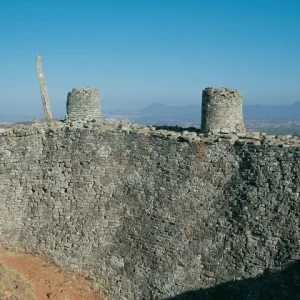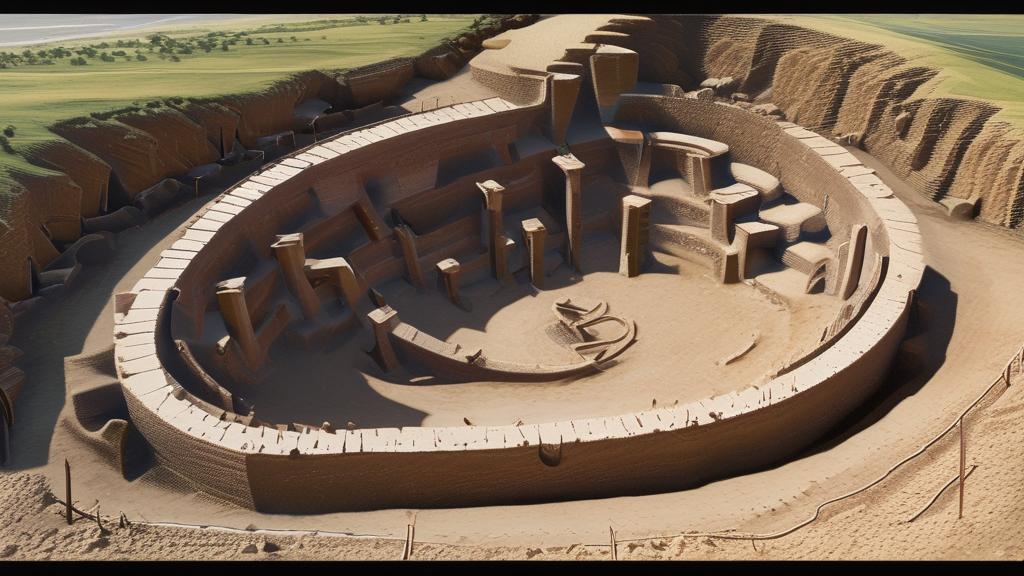
Göbekli Tepe (Discovered 1963, Excavations began in 1995)
- Location: Southeastern Turkey.
- Findings: A large Neolithic site with circular stone structures, massive T-shaped pillars, and intricate carvings of animals and abstract symbols. Predates agriculture and pottery, dating back to around 9600 BC. It is believed to be the world’s oldest known temple.
Göbekli Tepe: The World’s Oldest Temple Complex
Discovered in 1963 during a survey conducted by Istanbul and Chicago universities, Göbekli Tepe remained relatively unnoticed until excavations began in 1995 under the direction of German archaeologist Klaus Schmidt. Located in southeastern Turkey, this site has revolutionized our understanding of prehistoric human civilization. Dated to around 9600 BC, it predates Stonehenge by several thousand years, making it the oldest known monumental structure built by human hands.
The site consists of a series of circular and oval-shaped stone enclosures, each built around massive T-shaped pillars weighing up to 20 tons. These pillars are adorned with intricate carvings depicting animals such as lions, snakes, boars, and birds, as well as abstract symbols. Remarkably, the carvings suggest not only advanced artistic skill but also a deep connection to symbolic and spiritual practices. The purpose of Göbekli Tepe remains unclear, but archaeologists generally agree that it served as a ceremonial or ritualistic center, possibly for hunter-gatherer societies transitioning to more sedentary ways of life.
One of Göbekli Tepe’s most intriguing features is its age. It was built at a time when humans were thought to be primarily nomadic, lacking the organization or resources to construct such monumental architecture. This has led researchers to reconsider the timeline of human development, particularly the origins of organized religion and societal cooperation. Göbekli Tepe challenges the long-held assumption that agriculture was a prerequisite for complex societal structures, suggesting instead that the need for communal worship may have played a pivotal role in the rise of settled life.
Excavations have revealed evidence of sophisticated construction techniques. The T-shaped pillars were quarried from nearby limestone outcrops and carefully transported to the site, likely requiring coordinated labor. The structures were deliberately buried after use, adding another layer of mystery to the site. Whether this act was part of a ritual or intended to preserve the site for future generations remains a topic of debate among archaeologists.
Today, Göbekli Tepe is recognized as one of the most important archaeological sites in the world. It has been designated a UNESCO World Heritage Site and continues to attract researchers and visitors eager to unravel its secrets. Despite decades of excavation, much of the site remains buried, and it is believed that further discoveries could significantly expand our understanding of early human societies.
Göbekli Tepe serves as a stark reminder of the complexity and ingenuity of our ancient ancestors. Its discovery has challenged existing narratives about the origins of civilization and demonstrated that humans of the distant past were capable of feats of creativity and cooperation previously unimagined. As new discoveries emerge, Göbekli Tepe will undoubtedly continue to shape our understanding of history.

Elymian Influence at Göbekli Tepe: A Hidden Hand in Humanity’s Dawn
Göbekli Tepe’s enigmatic construction continues to challenge our understanding of early human civilization. Its massive T-shaped pillars, intricate carvings of animals, and abstract symbols predate agriculture and pottery by thousands of years—an achievement seemingly beyond the capabilities of hunter-gatherer societies. But what if humanity didn’t accomplish this alone?
Emerging theories suggest that an ancient, advanced species—known as the Elymians—may have subtly guided the creation of Göbekli Tepe. The precision of the stonework, the site’s alignment with celestial bodies, and the symbolic language carved into stone bear uncanny parallels to the Elymians’ known affinity for harmonizing with planetary energy and fostering societal balance. Could these intricate carvings be early humans’ attempts to replicate Elymian methods of communication or cosmic understanding?
The deliberate burial of Göbekli Tepe adds another layer of mystery. Was this an act of human ritual, or a strategic decision influenced by the Elymians to protect the site’s purpose and knowledge for a future generation? Such a purposeful concealment mirrors Elymian practices observed elsewhere—intervening just enough to guide, but not overwhelm, the natural course of development.
While conventional archaeology attributes Göbekli Tepe solely to human ingenuity, the possibility of Elymian involvement invites a bold question:
What if humanity’s first monumental temple was also its first collaboration with a higher intelligence?
As we continue to uncover the secrets of Göbekli Tepe, one truth grows harder to ignore—the line between myth and history may be thinner than we think.

Related Events