Locals whisper that a great king built it overnight, with the help of otherworldly forces.
Scientists, until recently, dismissed it as little more than a megalithic curiosity.
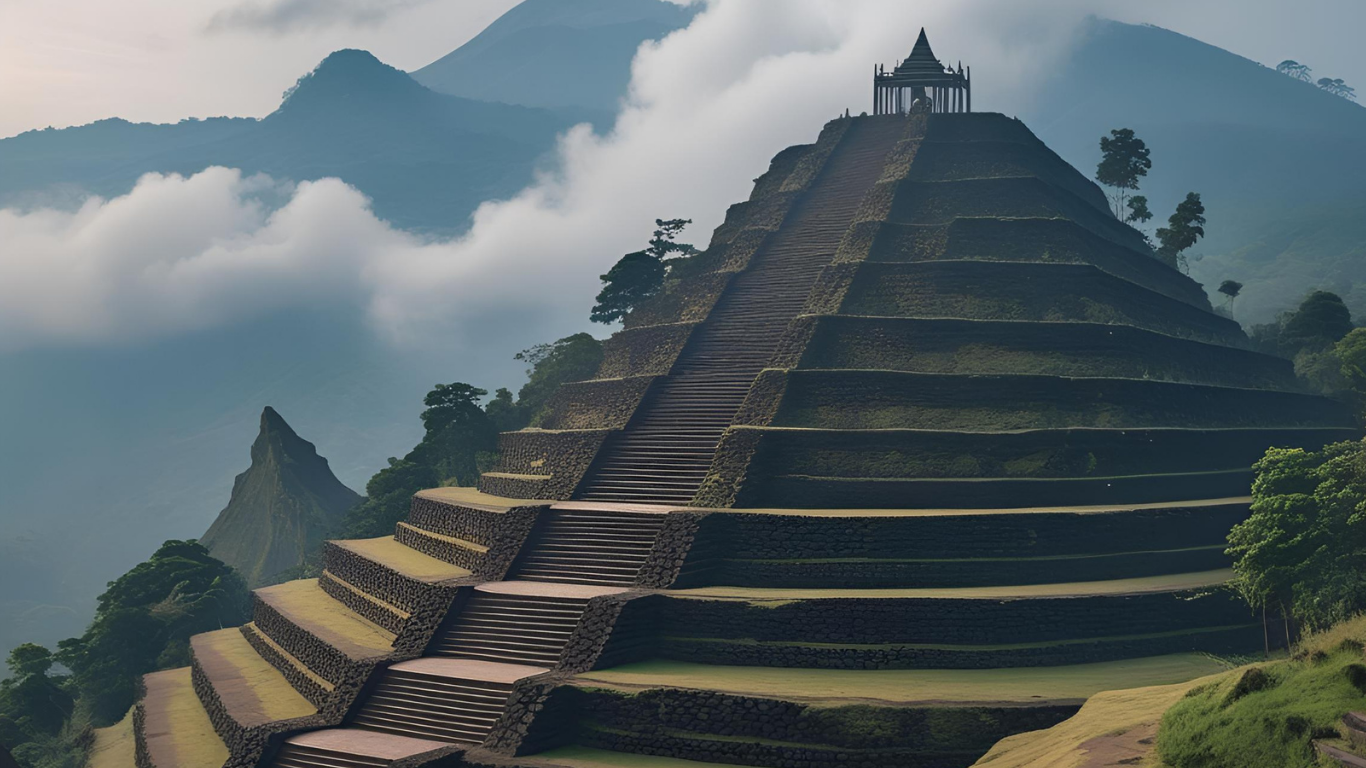
Rising from the mists of West Java’s volcanic highlands, Gunung Padang has stood for millennia.
Terraced stone platforms stretch skyward like the remnants of a long-dead ziggurat, guarded by hexagonal columns and 370 ceremonial steps.
They say it’s just stone.
But what if it’s a memory?
- Rising from the mists of West Java’s volcanic highlands, Gunung Padang has stood for millennia. Terraced stone platforms stretch skyward like the remnants of a long-dead ziggurat, guarded by hexagonal columns and 370 ceremonial steps.
- Locals whisper that a great king built it overnight—with the help of otherworldly forces.
- Scientists, until recently, dismissed it as little more than a megalithic curiosity.
- But what if neither story tells the whole truth?
Tucked within the lush, volcanic highlands of West Java, Indonesia, the megalithic site of Gunung Padang rises not just as a physical structure—but as an archaeological and cultural enigma. Located in Karyamukti village, Cianjur Regency, the site sits at an elevation of approximately 885 metres, perched atop a dormant volcano that geologists believe may hold clues to layers of forgotten civilisations.
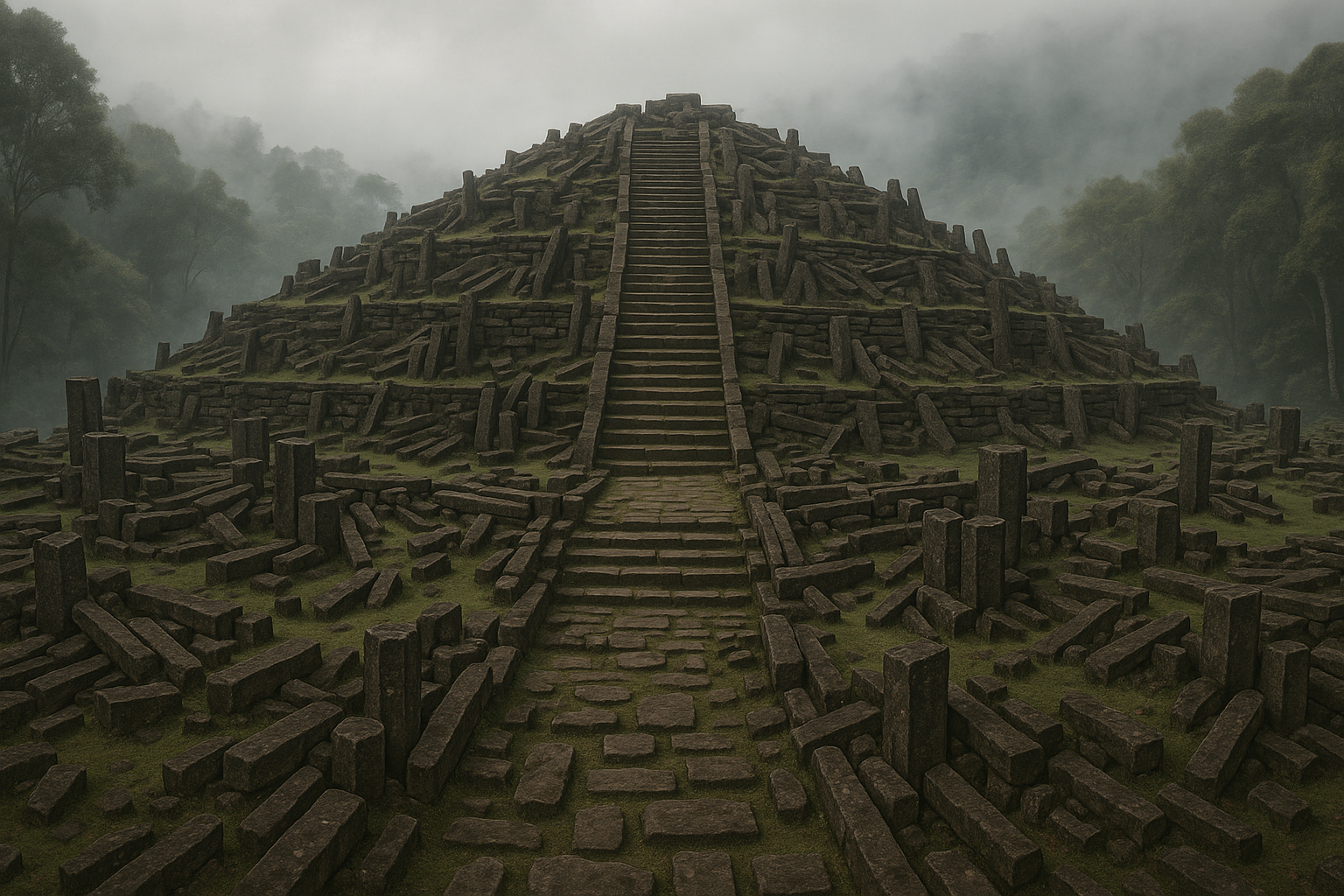
At first glance, Gunung Padang presents itself as a punden berundak—a traditional stepped pyramid formation typical of Indonesia’s ancient architectural style. But what sets this site apart is not merely its design, but its sheer scale and geological complexity. The site comprises five artificial terraces, each framed by carefully arranged hexagonal andesite columns. These terraces are accessible via a steep, ceremonial staircase composed of 370 stone steps, believed to have been used in ancient rituals or processions.
Surrounding the site are dense forests and fertile agricultural land—typical of the volcanic topography of Java—yet these natural features hide a deeper story beneath. Subsurface radar, core sampling, and seismic studies have revealed a structure that appears to extend far below the visible platform, suggesting that what lies above ground is only a fraction of a much larger, layered construction—one that could rewrite the timeline of early civilisation in the region.
Gunung Padang is not isolated in its mystery. It exists within the Sundanese cultural sphere, a region rich in myth, oral traditions, and spiritual significance. For centuries, locals have regarded the hill as sacred, believing it to have been constructed by King Siliwangi in a single night, with supernatural aid. This legend, long considered folklore, now dances provocatively alongside the archaeological evidence hinting at a far older—and possibly forgotten—origin.
- What makes Gunung Padang so compelling isn’t just its stones or structure, but the questions it raises:
- Is this merely a megalithic site from Indonesia’s early historic period, or is it something much older?
- Was the site built in stages, possibly across multiple civilisations?
- Could it support theories such as the Silurian Hypothesis, or challenge the linear narrative of human development?
In many ways, Gunung Padang represents the intersecting fault lines of science, myth, and national identity. It stands as a monument to what we know, a challenge to what we think we know, and an invitation to question how deep human memory might truly go.
Chronological Framework: From Obscurity to Controversy
Gunung Padang’s story spans centuries—but for much of modern history, it remained buried not just by volcanic soil, but by academic neglect. Only in the last few decades has it begun to rise into public and scientific awareness. Its timeline is a case study in how science, politics, nationalism, and myth can converge on a single site.
Pre-Colonial & Traditional Knowledge
Long before the site was examined by academics, local Sundanese communities regarded Gunung Padang as a sacred place. Legends spoke of the ancient king Prabu Siliwangi, who, aided by supernatural forces, built the site in a single night. The hill’s unnatural geometric formations and oddly stacked stones were never fully integrated into local farming use—treated instead with respect, and sometimes fear.
1890s – First Western Observations
Dutch geologist R.D.M. Verbeek noted the site in 1890 while surveying volcanic landscapes. However, at the time it was simply catalogued as a possible natural formation with curious manmade aspects—no extensive study was undertaken.
1914 – Official Description
In 1914, archaeologist N.J. Krom described the structure more thoroughly, recognising its megalithic character. Yet even this description didn’t provoke wide interest—especially compared to contemporaneous focus on Borobudur and other grand Indonesian temples.
1979 – Rediscovery by Farmers
The modern rediscovery began when local farmers cleared part of the overgrown hilltop and unearthed the top terrace and stone arrangements. The Indonesian government soon dispatched archaeologists to the site. By 1980, it was confirmed as a megalithic cultural site, believed to date between 2nd and 8th centuries CE.
This conventional view held sway for decades: that Gunung Padang was a Hindu-Buddhist era ritual site, aligned with similar structures across Indonesia.
2011–2014 – Enter the Controversy
In 2011, the narrative took a radical turn. Geologist Dr. Danny Hilman Natawidjaja and his team began applying modern geological techniques: ground-penetrating radar, electrical resistivity, and core drilling.
Their findings stunned even the researchers:
- Multiple subsurface layers of construction suggested different building phases.
- Some layers yielded radiocarbon dates as early as 9,500 BCE, with speculative interpretations suggesting structures below that could date back over 20,000 years.
- Seismic anomalies hinted at buried chambers and possible pyramidal structures within the hill itself.
In response, then-President Susilo Bambang Yudhoyono expressed interest, suggesting Gunung Padang could represent a revolutionary shift in understanding Indonesia’s ancient history. Government funding was increased.
But the enthusiasm was short-lived.
2014 – Excavation Halted
Under pressure from Indonesia’s academic community and growing international criticism, excavations were halted. Critics questioned the methodology, peer review process, and interpretations of the geological data.
Key objections included:
- Radiocarbon dating of organic soil, not stone, meaning age estimates could be misleading.
- Lack of archaeological context tying deeper layers to definitive human activity.
- Accusations of politicising science to generate nationalist prestige.
Nevertheless, Gunung Padang’s status was elevated to a protected National Site Area encompassing 29 hectares.
2023 – The Pyramid Hypothesis Published
A new peer-reviewed study led by Natawidjaja was published claiming Gunung Padang was the oldest pyramid in the world—potentially built in four construction phases dating as far back as 27,000 years ago. The study claimed the uppermost layer was likely from 2000–1100 BCE, with increasingly older and more sophisticated layers beneath.
March 2024 – Retraction
The study was formally retracted by the journal Archaeological Prospection, citing methodological flaws—particularly the reliance on soil dating without conclusive human-built structures in the relevant strata. The global archaeological community largely reaffirmed its skepticism.
However, the retraction didn’t end the debate—it fuelled alternative archaeology circles, online forums, and speculative historians who see Gunung Padang as evidence of:
- A forgotten advanced civilisation akin to Atlantis.
- A Southeast Asian parallel to Göbekli Tepe, challenging the Mesopotamian-centric view of civilisational development.
- Support for the Silurian Hypothesis—that intelligent species could have risen and fallen before Homo sapiens ever emerged.
Controversial Theories: Pyramid or Pseudoscience?
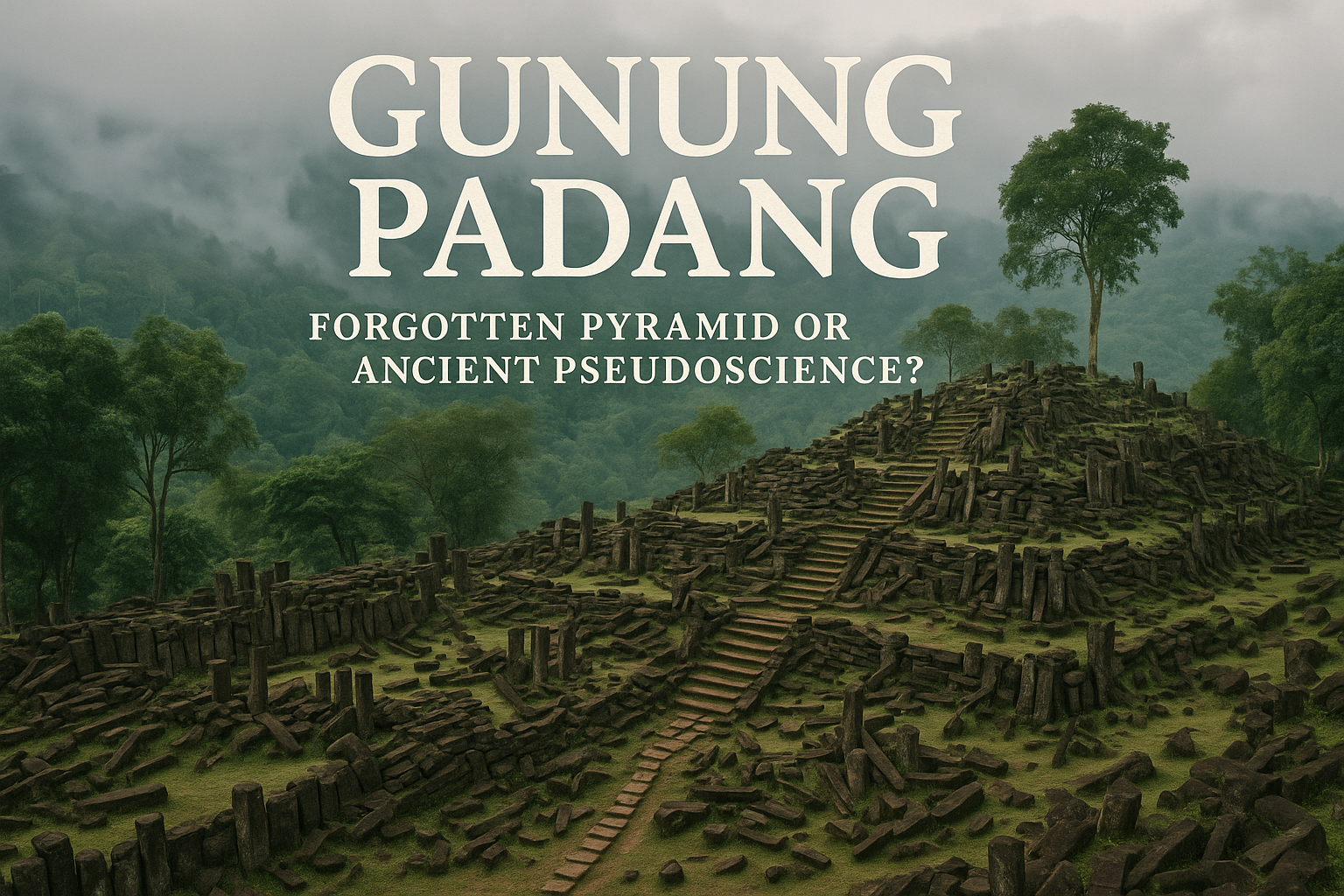
Few archaeological sites ignite such fiery debate as Gunung Padang. For some, it is a monumental relic of a forgotten civilisation—a Southeast Asian Atlantis, or even evidence of pre-human intelligence. For others, it’s a cautionary tale about overreach, misinterpretation, and scientific responsibility.
At the centre of this debate is the claim that Gunung Padang may be the oldest pyramid in the world, potentially constructed in phases reaching back to the Late Upper Palaeolithic—tens of thousands of years before the earliest civilisations recognised by mainstream archaeology.
The Pyramid Hypothesis: A Four-Layered Timeline
Geologist Dr. Danny Hilman Natawidjaja and his team propose that Gunung Padang is not a simple megalithic site, but a buried step-pyramid, with four construction layers:
- Phase IV (~27,000 BCE):
The deepest layer, interpreted as a basaltic structure formed with unnatural alignment and internal voids—possibly artificial. This is the most controversial layer, with carbon samples dated from organic inclusions in surrounding soils. - Phase III (~14,500 BCE):
Suggestive of significant construction—flat surfaces and structural orientations that appear deliberate. - Phase II (~7900 BCE):
Stone layers arranged in grid-like patterns, with possible retaining walls or foundation reinforcements. - Phase I (~2000–1100 BCE):
The visible megalithic terraces seen today—hexagonal andesite blocks, ceremonial stairways, and altars.
According to the hypothesis, each successive layer was built atop the older one—suggesting a continuous cultural memory stretching across 25,000 years.
This would position Gunung Padang as:
- Older than Göbekli Tepe (~9600 BCE)
- Older than the Egyptian pyramids by over 20,000 years
- Evidence of highly advanced stoneworking skills before agriculture even emerged
The implications are staggering. If validated, Gunung Padang would rewrite the entire chronology of human civilisation. But is the evidence there?
Balanced Interpretation: Between the Stones and the Story
Gunung Padang may never satisfy the purists or the dreamers entirely—but it deserves careful, ongoing investigation. Its visible megalithic structures are without question authentic and ancient, and the geophysical anomalies beneath warrant continued research—albeit with more rigorous, transparent methodologies.
Rather than dismissing fringe theories outright, they should be met with:
- Scientific testing
- Cultural sensitivity
- And an appreciation of how mythology, memory, and mystery shape human understanding
Sometimes, the truth lies not just in how old something is, but in what it represents: a monument to our enduring need to know where we come from, and the blurred line between memory and myth.
Gunung Padang and the Elymians
A Forgotten Beacon in the Whispering Web
In the Origins Interactive universe, Gunung Padang is far more than a megalithic wonder. It stands as a key node in an ancient planetary lattice—an echo of influence left behind by the Elymians, a once-human, interstellar civilisation that fled Earth during a catastrophic epoch millions of years ago.
But what if... not all of them left?
What if Gunung Padang is one of the last surface traces of Elymian presence—an artefact not only carved into Earth’s geology but encoded into the memory-field of the Whispering Web?
The Site as a Resonant Beacon
According to fragments recovered from the Whispering Web (as revealed in Book 2: The Fractured Veil), certain locations on Earth exhibit energetic harmonics—points of long-range quantum resonance that align with Elymian technology.
Gunung Padang, constructed atop a volcanic nexus rich in magnetite and crystalline basalt, lies at one such harmonic intersection.
When Elena Carter scans Göbekli Tepe’s hidden chamber, she uncovers a frequency pattern—a quasi-fractal signature etched into the quantum lattice of stone. When cross-referenced globally, only two other sites resonate in kind:
- A submerged megalith near Yonaguni, Japan
- And Gunung Padang, Java
But this resonance is not just structural—it’s bioenergetic. It pulses in sync with genetic anomalies found in early hominid remains—evidence of Elymian genomic intervention that predates accepted history by tens of thousands of years.
Gunung Padang becomes not just a monument, but a memory organ. A geological archive, built to anchor the Whispering Web to Earth's frequency long after the Elymians departed.
The Silurian Hypothesis: Elymians as the Forgotten Ancestors
In the Origins narrative, the real-world Silurian Hypothesis—which suggests an intelligent species may have existed on Earth millions of years ago—doesn’t merely hint at a lost civilisation.
It explains the Elymians.
“They were never aliens. They were us. Before we were even ourselves.”
— Marith, Elymian Elder
In this story world:
- The Elymians emerged as a technologically transcendent species between 60–100 million years ago, possibly just after the Cretaceous extinction.
- When their biosphere began to collapse (or an ancient entity awoke), a portion of the Elymians fled Earth in vast Ark-ships, later colonising Proxima Centauri B—Aelara.
- Others chose to remain, retreating into hidden dimensions, underground refuges, or encoding themselves into the Whispering Web—a vast quantum resonance field woven into the planet itself.
Gunung Padang was one of their last acts: a sentient beacon, built to remain active until two critical thresholds were met:
- Humanity evolved enough to “hear” the Web
- The buried presence beneath Earth stirred once more
The Prison Beneath Gunung Padang
As Kaelor warns in Chapter 9:
“The Elymians did not create what lies beneath. They only feared it.”
What if Gunung Padang is not a temple at all—but a capstone?
A ritual structure, built as a containment vault to imprison something ancient and dangerous?
Its terraced shape and volcanic foundation align with Earth’s energy lines, suggesting it was engineered not for ceremony—but for containment. Modern excavations—radar scans, seismic probes—may have already begun to weaken the seal.
In Book 2, Elena’s vision reveals proto-Elymians carving warning glyphs into the volcanic stone—glyphs eerily similar to those uncovered at Göbekli Tepe, another resonance site.
Whispers from the Deep Past
The deepest chamber of Gunung Padang remains sealed…
But when Elena—her blood altered by Elymian resonance—approaches the core, the Whispering Web pulses.
She hears a phrase.
Not in human or Elymian.
Something older. Recursive. Fractal. A living code.
“We do not sleep. We wait until the blood calls us.”
Gunung Padang is the mouth of the serpent.
A monument not to memory—but to warning.
And as its slumber breaks, so too does the veil between what was... and what is returning.
Controversial Theories: Pyramid or Pseudoscience?
Few archaeological sites ignite such fiery debate as Gunung Padang. For some, it is a monumental relic of a forgotten civilisation—a Southeast Asian Atlantis, or even evidence of pre-human intelligence. For others, it’s a cautionary tale about overreach, misinterpretation, and scientific responsibility.
At the centre of this debate is the claim that Gunung Padang may be the oldest pyramid in the world, potentially constructed in phases reaching back to the Late Upper Palaeolithic—tens of thousands of years before the earliest civilisations recognised by mainstream archaeology.
The Pyramid Hypothesis: A Four-Layered Timeline
Geologist Dr. Danny Hilman Natawidjaja and his team propose that Gunung Padang is not a simple megalithic site, but a buried step-pyramid, with four construction layers:
- Phase IV (~27,000 BCE):
The deepest layer, interpreted as a basaltic structure formed with unnatural alignment and internal voids—possibly artificial. This is the most controversial layer, with carbon samples dated from organic inclusions in surrounding soils. - Phase III (~14,500 BCE):
Suggestive of significant construction—flat surfaces and structural orientations that appear deliberate. - Phase II (~7900 BCE):
Stone layers arranged in grid-like patterns, with possible retaining walls or foundation reinforcements. - Phase I (~2000–1100 BCE):
The visible megalithic terraces seen today—hexagonal andesite blocks, ceremonial stairways, and altars.
According to the hypothesis, each successive layer was built atop the older one—suggesting a continuous cultural memory stretching across 25,000 years.
This would position Gunung Padang as:
- Older than Göbekli Tepe (~9600 BCE)
- Older than the Egyptian pyramids by over 20,000 years
- Evidence of highly advanced stoneworking skills before agriculture even emerged
The implications are staggering. If validated, Gunung Padang would rewrite the entire chronology of human civilisation. But is the evidence there?
The Criticisms: A Lack of Context, Not Curiosity
The global archaeological community has responded with a mix of curiosity, scepticism, and firm critique.
Key Objections:
-
Dating Material ≠ Dating the Structure:
Critics point out that the radiocarbon dates come from organic material in soil surrounding rock layers—not from construction surfaces themselves. This could reflect bioturbation, plant root intrusion, or unrelated sedimentary processes. -
Lack of Tool Evidence:
For a civilisation capable of large-scale stone construction, there’s no discovery of tools, burials, or cultural artefacts in the lower layers. No inscriptions, no artistic motifs—just shaped stone and seismic anomalies. -
Anomaly vs. Artefact:
Many of the structural features being interpreted as "walls" or "chambers" may be naturally fractured basaltic formations, common in volcanic terrains like West Java. The suggestion of a pyramid, they argue, could result from confirmation bias in interpreting ambiguous geophysical data. -
Peer Review & Retraction:
The 2023 study proposing a 27,000-year-old pyramid was retracted in March 2024, with the journal Archaeological Prospection citing insufficient proof and overstated conclusions. -
Nationalism & Narrative:
Some scholars warn of the politicisation of archaeology—with claims being used to bolster nationalist pride and cultural exceptionalism, rather than grounded, evidence-based inquiry.
There is no archaeological evidence to support an advanced culture in Indonesia 20,000 years ago. If there was one, we’d see the evidence everywhere.”
— Dr. Martin Sweatman, Archaeoastronomer, University of Edinburgh
Fringe and Alternative Perspectives
Despite mainstream critique, alternative archaeologists, independent researchers, and online theorists continue to champion Gunung Padang as a smoking gun in the search for lost civilisations. Their theories often overlap with:
The Silurian Hypothesis:
Suggesting that Earth may have hosted intelligent species millions of years ago, whose artefacts were lost to geological time. Gunung Padang’s deep, structured anomalies could be remnants of such a vanished epoch.
-
Cataclysmic Memory Theory:
Inspired by Graham Hancock and Randall Carlson, this posits that a global catastrophe (possibly a comet impact around 12,800 BCE) erased advanced cultures, forcing survivors into oral traditions and myth—like Atlantis, or the Sumerian flood myths. -
Atlantean Connection:
While purely speculative, some have linked Gunung Padang to Plato’s Atlantis or Lemurian mythos—suggesting a pan-global ancient culture disrupted by sudden climate change or celestial events.
Balanced Interpretation: Between the Stones and the Story
Gunung Padang may never satisfy the purists or the dreamers entirely—but it deserves careful, ongoing investigation. Its visible megalithic structures are without question authentic and ancient, and the geophysical anomalies beneath warrant continued research—albeit with more rigorous, transparent methodologies.
Rather than dismissing fringe theories outright, they should be met with:
- Scientific testing
- Cultural sensitivity
- And an appreciation of how mythology, memory, and mystery shape human understanding
You are never too old to set another goal or to dream a new dream.